
I’d like to investigate the information design procedure, concentrating on visual design thinking.
I’m focusing on Dan Roam’s method from Back of the Napkin because it’s concise, direct, and to the point. The first step in the information design process is identifying the issue and creating a plan based on the data and research you’ve gathered. In light of this, the next stage is to begin sketching when we have determined our issue and established our concept.
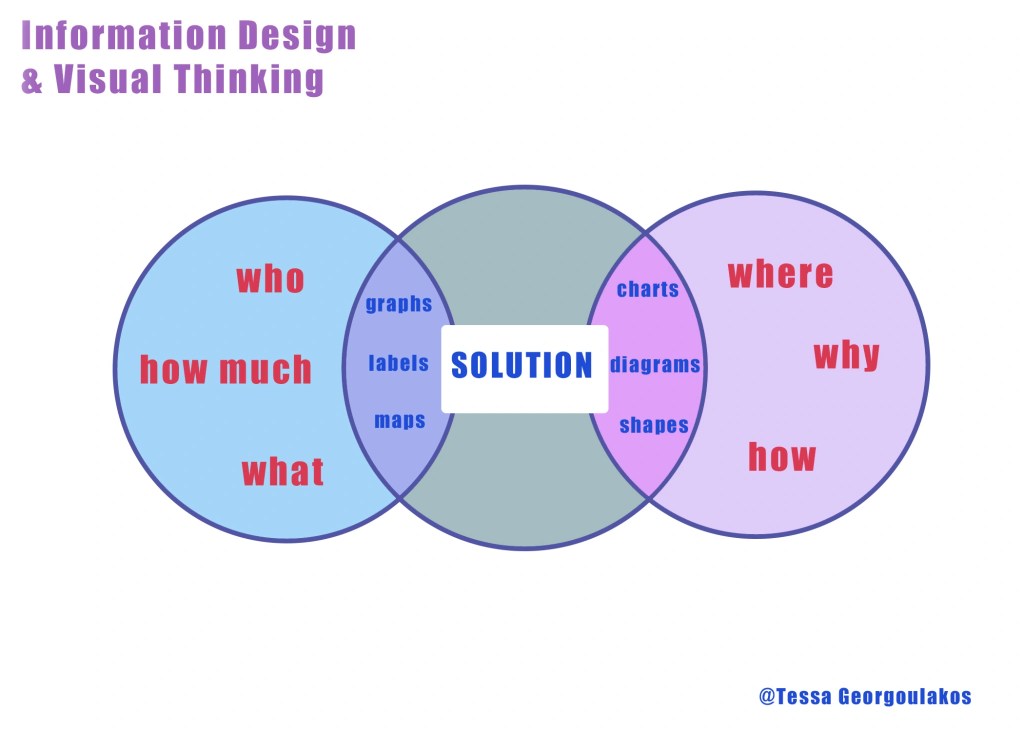
But how do we start with that? Who are your clients? We need to first create a portrait to illustrate a who/what issue.
To start, Dan Roam proposes that we sketch an image of who we consider to be our ideal client. This depiction doesn’t have to be complex; even the simplest ones can pique our clients’ interest. It’s actually best to use circles, squares, and various other shapes in producing your picture because simple shapes/objects are quickly recognizable. We need to name our shapes because that supports the visual areas of our brains. Without a name, what would a circle mean? Most likely, we would make one on our own (Roam).
I liked his suggestion to show “us,” as doing so will put “us” in the proper frame of mind to consider our “customer”. How many clients do we have, exactly? How much do they purchase?
Pie charts, bar charts, and numerical charts that use data with few images can help us make our point, hold the client’s attention, and would be able to help answer our questions.
The place of our business is the next step in our chart to address a problem. Maps can be used to display the location, closeness, distance, and direction of one object in relation to another object. They can be landscapes, organizational charts, Venn diagrams, and other types of maps (Roam). We can now discuss when we can fix the problem and how long it will take. Will it take a few days, a month, or years?
Once we have a firm grasp on the issue, we can begin creating solutions and the specifics of what we’re going to construct.
How can we make our company better? How can problems be fixed? Why both the effort and the expense? All of the questions must be answered. In order to do that, we need to consider who our rivals are and how they plan to grow. We must research client purchasing patterns and technological advancements that may affect revenues (Roam). The more we see how everything functions, the more we can understand how things will come to be.
If I ever get the chance to build a business plan, which is something I’d like to do, I’d use this technique in that circumstance. I am aware that I must distinguish myself from my competitors and demonstrate why my method or design is preferable. I believe that what Roam says about how his information design method may help the other firm is something I could do as well, but to demonstrate how my business might serve everyone. I need a target market, to research price and revenue information, as well as have the ability to address an issue and demonstrate a realistic solution.
I believe that adding more talking points next to your image would help in the process. Although we have the ability to perceive and imagine, we have never been taught how to communicate what we see to others (Roam). Throughout this process, we need to be able to think about the possible outcomes of our image and fill in the blanks. We’ll then discuss why we have to do this and make our argument. We must understand the different perspectives through which ideas can develop. That’s why it’s important that you use maps, infographics, and diagrams to support your research.
The labeling of the image was an important step he included as well, which helps the viewer understand what they are intended to be looking at. He has shown the image as something simple rather than overly complicated. Although I agree that there are many processes, I wouldn’t eliminate any of them because they are all crucial to the process of visual thinking.
This should make certain that all of the who, what, why, how, etc. inquiries are answered, leaving no questions left.
Works Cited
Roam, Dan. Back of the Napkin : Solving problems and selling ideas with pictures, Marshall Cavendish International (Asia) Private Limited, 2012. ProQuest Ebook Central, http://ebookcentral.proquest.com/lib/empire-ebooks/detail.action?docID=1389174.
 Tech with Tess